
Conservatory Cost in the UK
A new conservatory in the UK costs £9,000 to £25,000 installed, and most people who search for that number already own one: the replacement roof they are actually pricing is £6,000 to £11,000. This guide sets out both, with the source, the spread and the last-checked date behind every figure, so you can tell an evidenced price from a marketing number.
£8,000 to £13,000●●●○○Reasonably evidenced
A uPVC lean-to conservatory, 3m × 3m, installed including VAT, typically £10,000, from two independent UK publishers who agree on the £8,000 floor to the pound. Prices checked 20 August 2026.
£6,000 to £11,000●●●●○Well evidenced
Replacing the roof on the conservatory you already have, at the same size, typically £8,075 as the median of five sourced estimates. The best evidenced figure we hold: four UK publishers price the same job. Prices checked 20 August 2026.
Across both jobs, what decides the price, in order, is the roof, then the size, then the style.
Conservatory prices by style and size, 2026
Whole-build installed totals including VAT: frame, glazing, roof, base, dwarf wall where the style carries one, and fitting. Two jobs get called the same thing, and most people who search this already own a conservatory. If that is you, the number you want is the roof one: at 3m × 3m that is £8,075 against £10,000 to build the whole thing new, so it is most of the price rather than a fraction of it.
| Style and size | Low | Typical | High | Sources | Evidence |
|---|---|---|---|---|---|
| Lean-to, 3m × 3m (9 m²) | £8,000 | £10,000 | £13,000 | 2 | ●●●○○Reasonable |
| Victorian, 4m × 3m (12 m²) | £11,000 | £12,100 | £18,000 | 2 | ●●●○○Reasonable |
| Edwardian, 4m × 3m (12 m²) | £10,000 | £12,750 | £19,000 | 2 | ●●●○○Reasonable |
| Gable end, 4m × 4m (16 m²) | £14,400 | £14,500 | £16,000 | 2 | ●●●○○Reasonable |
| P-shape, 15 to 20 m² | £13,250 | £16,750 | £19,700 | 3 | ●●●●○Well |
| Bay Victorian, any size | No UK source publishes a price | 0 | ○○○○○Gap | ||
The Edwardian 4m × 3m floor is a genuine 1.30× disagreement between two publishers fifteen months apart, so the band is published wide and the typical is marked derived rather than picking a winner. Bay Victorian is a style installers actively sell and nobody in the UK publishes a price for it, so we say so instead of inventing one.
How the five conservatory styles differ
Conservatory prices vary depending on the size and the style more than on anything else you choose. Five conservatory styles account for almost every quote a UK homeowner is given, and the gap between the cheapest and the dearest of them at a comparable footprint is roughly twice the price.
Lean-to conservatories are the cheapest style to build. A plain rectangular plan and a single pitched roof mean less frame, less glazing and less labour, which is why every publisher's cheapest row is a lean-to: ours is £8,000 to £13,000 at 3m × 3m. A Victorian conservatory adds a faceted bay and the extra frame members that come with it, and an Edwardian conservatory trades that bay for a square plan that uses the floor area better at a similar price. Both land near £11,000 to £19,000 at 4m × 3m. A gable end raises the front elevation into a full pitched gable, so it carries more glazing than an Edwardian of the same footprint. At the top of the range a P-shape is two rooms joined, and it prices like two rooms.
Shape drives the price before specification does: a plain plan at the footprint you need beats a faceted one you pay to heat. Comparing styles fairly means comparing them at the same footprint, which is what conservatory styles and what each one costs does, row by row at matched sizes. If a full-size build is more than you need, the small conservatory cost guide prices the compact end separately.
Already have a conservatory? The question changes completely. You are not pricing a new build, you are pricing a conservatory roof replacement: a solid roof on an existing 3m × 3m conservatory is £6,000 to £11,000 against £9,000 to £25,000 for starting again. It is the single best evidenced figure we hold, because it is the one job where four UK publishers price the same work. When you know your number, comparing conservatory roof quotes from up to four local installers is the next step.
If even the roof number is more than you want to spend, insulating the roof you have costs a fraction of replacing it. It solves the winter half of the problem and not the summer half, so it suits some conservatories and not others: the conservatory insulation cost guide prices the methods honestly, including where they do not work.
Conservatory Cost Calculator
Six questions. The answers change the number, and they are also exactly what an installer needs before they can quote. No phone number until the final step, and no email needed to see an estimate.
Step 1 of 6
Conservatory cost per square metre
A per square metre rate looks like the tidy way to compare quotes. It is not, because the rate falls as the roof grows: fixed costs like scaffolding, mobilisation and building control do not scale with area. We publish the reconciled rate as a cross-check on the size-banded totals above, never as a calculator input.
| What is priced | Low | Typical | High | Spread | Sources | Evidence |
|---|---|---|---|---|---|---|
| Tiled roof, installed, per m², all sizes | £460 | £650 | £900 | 1.96× | 3 | ●●●○○Reasonable |
| Whole build, all in, per m² | £1,500 | not published | £2,000 | 1.33× | 1 | ●○○○○Thin |
| Structural only, per m², by style | £875 | not published | £1,050 | 1.20× | 1 | ●○○○○Thin |
The tiled roof rate is the row four publishers disagree on most loudly: one national cost publisher's own on-page estimator quotes £195/m² against £750/m² in the same page's body copy, a 3.8× contradiction we exclude and publish rather than average. The £875 to £1,050 structural-only band against £1,500 to £2,000 all-in is itself the clearest published evidence of how much of a conservatory price is not the conservatory. The full method, including why the typical £650 is marked derived, sits on the conservatory cost per square metre page.
Cost by frame material: uPVC, aluminium and timber
Frame material moves the whole-build total by a predictable percentage, and it is the percentage, not a price, that publishers actually agree on.
| Material | Low | Typical | High | Sources | Evidence |
|---|---|---|---|---|---|
| Aluminium premium over uPVC | +15% | +25% | +30% | 5 | ●●●●●Well |
| Timber premium over uPVC | +50% | +65% | +80% | 4 | ●○○○○Thin |
The aluminium +25% is the modal value across five sources including the only neutral editorial one, and one manufacturer's +40% is excluded as premium-tier. Timber is published for engineered softwood and standard hardwood only: bespoke oak is a different product and starts around £50,000. Material alone, supply only, runs at roughly £200 to £300 per m² for uPVC frame material against £300 to £400 for aluminium and £400 to £600 for timber, one publisher, checked 20 August 2026.
The industry claim about aluminium being the premium thermal choice is wrong. Aluminium is thermally worse than uPVC and timber: SAP 10.2 gives an aluminium window a whole-frame U-value of 2.1 W/m²K against 1.7 for uPVC and timber, and aluminium needs a thermal break to get anywhere near them. Price and thermal performance move in opposite directions here, and any site telling you otherwise is selling frames rather than checking them.
The base, foundations and dwarf wall
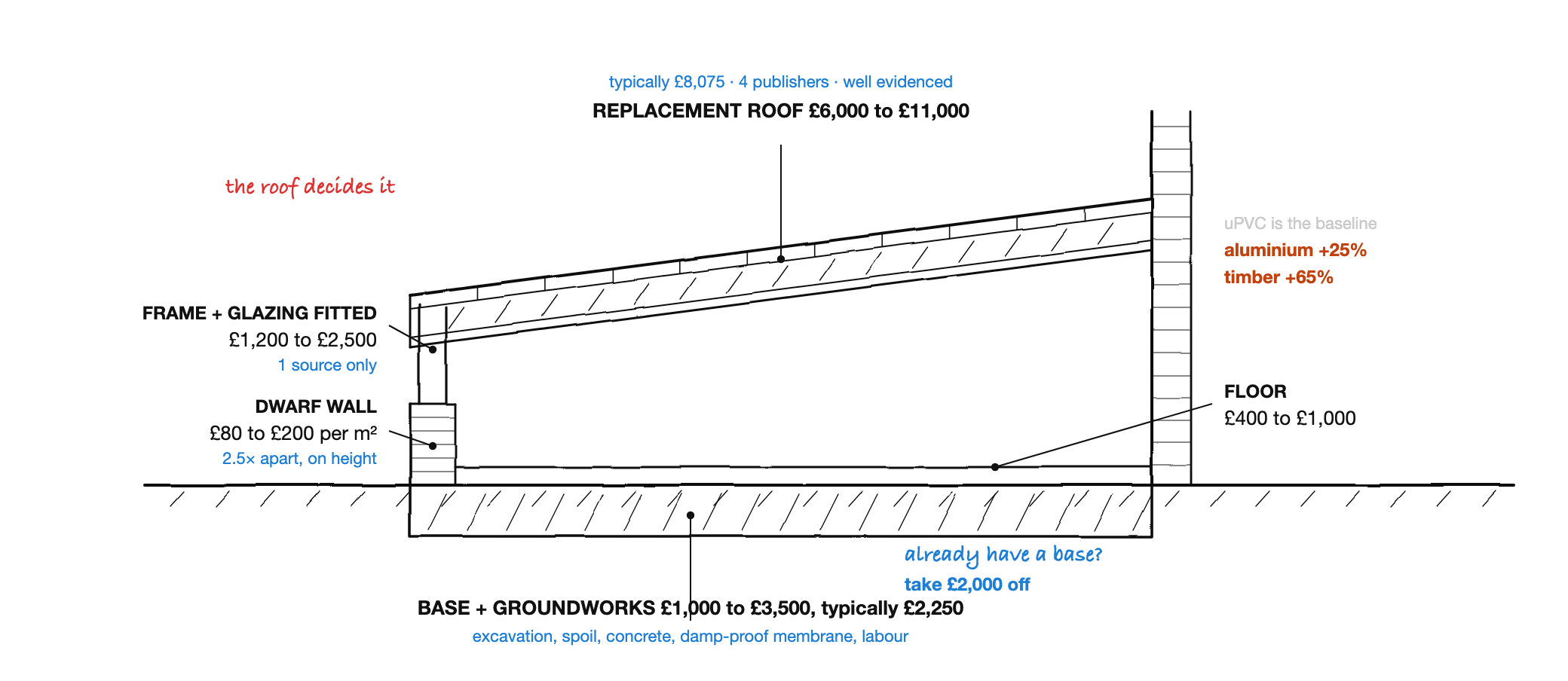
Every conservatory needs foundations, including a lean-to: the idea that a lightweight structure can skip them is the single most expensive misconception in this market. A conservatory base is real building work, and Fig. 0 at the top of this page prices each part of it in place.
| Item | Low | Typical | High | Sources | Evidence |
|---|---|---|---|---|---|
| Groundworks and foundations, whole job | £1,000 | £2,250 | £3,500 | 2 | ●●●○○Reasonable |
| Concrete base, per m² | not published | £90 | not published | 1 | ●○○○○Thin |
| Dwarf wall, per m² | £80 | not published | £200 | 2 | ●●●○○Reasonable |
The groundworks band is published as the union of two publishers, £1,000 to £3,500, because the intersection would be a false precision, and the £2,250 typical is derived and labelled as derived. The dwarf wall's 2.5× spread has an explanation, not a winner: the £80 floor is specified at 600 mm height and the £200 ceiling is not specified at all. No UK cost site publishes a dedicated conservatory base guide, so these rows were extracted from inside general guides, and we say so.
What is and is not in the price
Two quotes for "the same" conservatory can differ by thousands and both be honest: the cost of building a conservatory depends on what the installer counted. Every whole-build figure in our table means: frame, glazing, roof, base and groundworks, dwarf wall where the style carries one, fitting labour, and VAT.
None of our whole-build totals include the things that arrive later: the internal flooring finish (budget £60 to £110 per m² for laminate or tiles, one publisher, Thin), electrics, heating, blinds, removal of an existing structure, or building control fees where they apply. French doors instead of standard patio doors, underfloor heating instead of radiators, a roof lantern: every one will add to the cost, and none appears in the headline number. A supply-only kit price, meanwhile, is not a cheaper conservatory, it is a different purchase entirely, and mixing the two is the commonest way published conservatory prices are made to look cheap. Before you sign anything, read how to read a conservatory quote: it itemises what an honest quote contains and what to query.
Conservatory quotes: how many to get and what to compare
An estimate tells you whether a job is affordable. Only a quote tells you what it costs, because only an installer who has stood in your garden can price your base, your access and your existing frames.
Get three. Two is not enough to spot an outlier and four is more surveys than most people will sit through. When the three conservatory quotes arrive, they will not be comparable on price until you have made them comparable on scope, which is the whole reason this page publishes what is and is not in a figure. Check each one names the roof specification, states whether the base and groundworks are included, says whether the number is supply only or supply and fit, and shows the VAT position. Two quotes that differ by thousands are usually two different jobs.
Nothing on this page needs your phone number. Answer the six questions and you will see your estimate and its sources first; passing the details to installers is a separate decision at the end. If you already know you want the roof priced rather than a whole new build, conservatory roof quotes is the narrower version of the same thing.
What affects the cost of a conservatory, starting with the roof
Six things move the number, and they do not move it equally. In the order they affect the cost: the roof, the size, the style, the frame material, the base, and last of everything, the fittings people worry about first.
- The roof. The largest single lever, and the one detailed below.
- The size of the conservatory. Sets the glazing area and the base together, so it compounds. Priced by size above.
- The style of conservatory. Roughly a 2× spread at a comparable footprint. Priced by style above.
- The frame material. A predictable percentage on the whole build: +25% for aluminium, +65% for timber.
- The base and groundworks. £1,000 to £3,500, and invisible in most quotes.
- Everything after that. Flooring, electrics, blinds and underfloor heating are real money but they are not in the headline number.
Roof type moves the price more than anything else, and most people cannot name their roof material. The three below are cut through so you can match yours by looking at it.
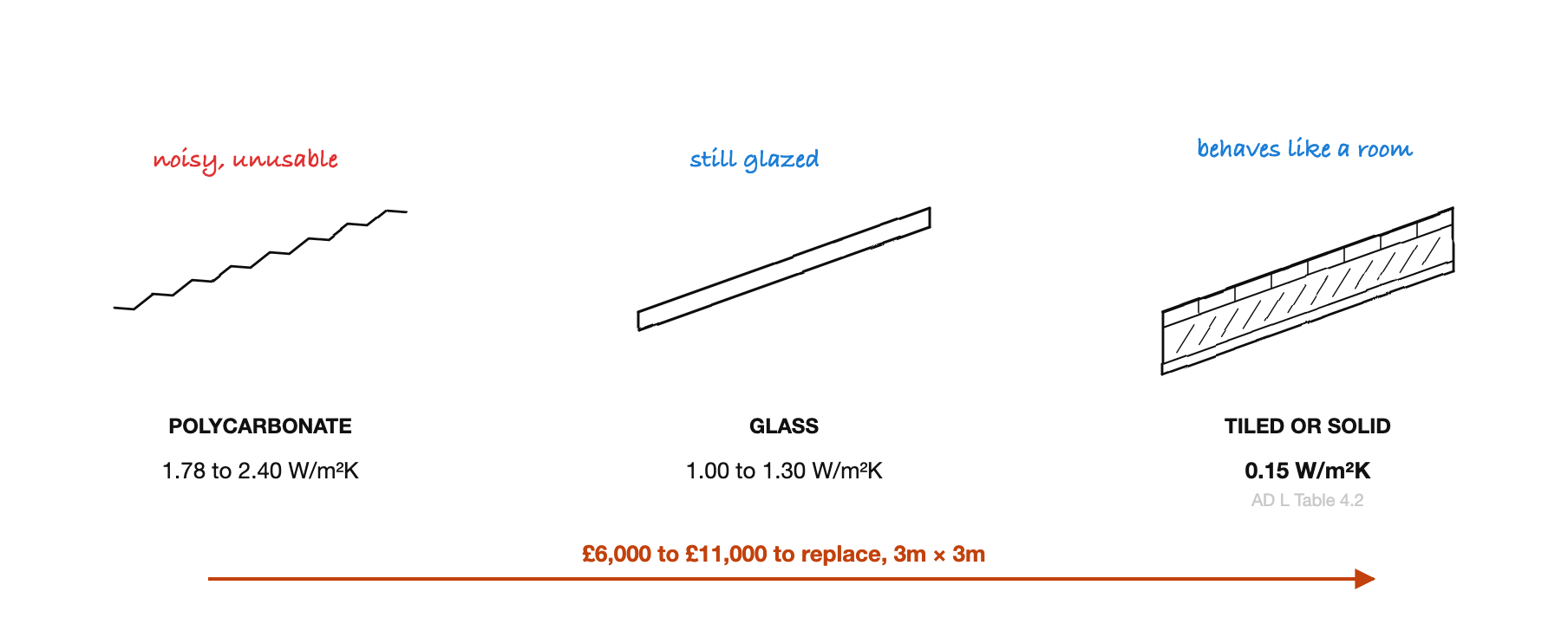
Polycarbonate
Corrugated, translucent, and the reason the room is unusable in July and January. The cheapest roof ever fitted to a UK conservatory.
£6,000 to £11,000
Glass
Clearer and quieter than polycarbonate: a glass roof is still a sealed double glazed unit, better than it gets credit for, but it will never behave like a room in the house.
£460 to £900 per m²
Tiled or solid
An insulated, plastered roof reaching 0.15 W/m²K. The most complete fix, and the one that turns the job into regulated building work.
£8,000 to £14,400
These three are the mainstream conservatory roof coverings, and the insulated systems sold under brand names are priced separately: the conservatory roof systems compared guide prices Guardian, UltraRoof, SupaLite and Equinox against each other, with their U-values and certifications.
Each of the three has its own costed guide: solid roof conservatory cost for what an insulated roof adds and saves, tiled conservatory roof replacement cost for the tiled systems specifically, and replacing a polycarbonate conservatory roof if that is what you are looking up at now.
Where the published prices disagree
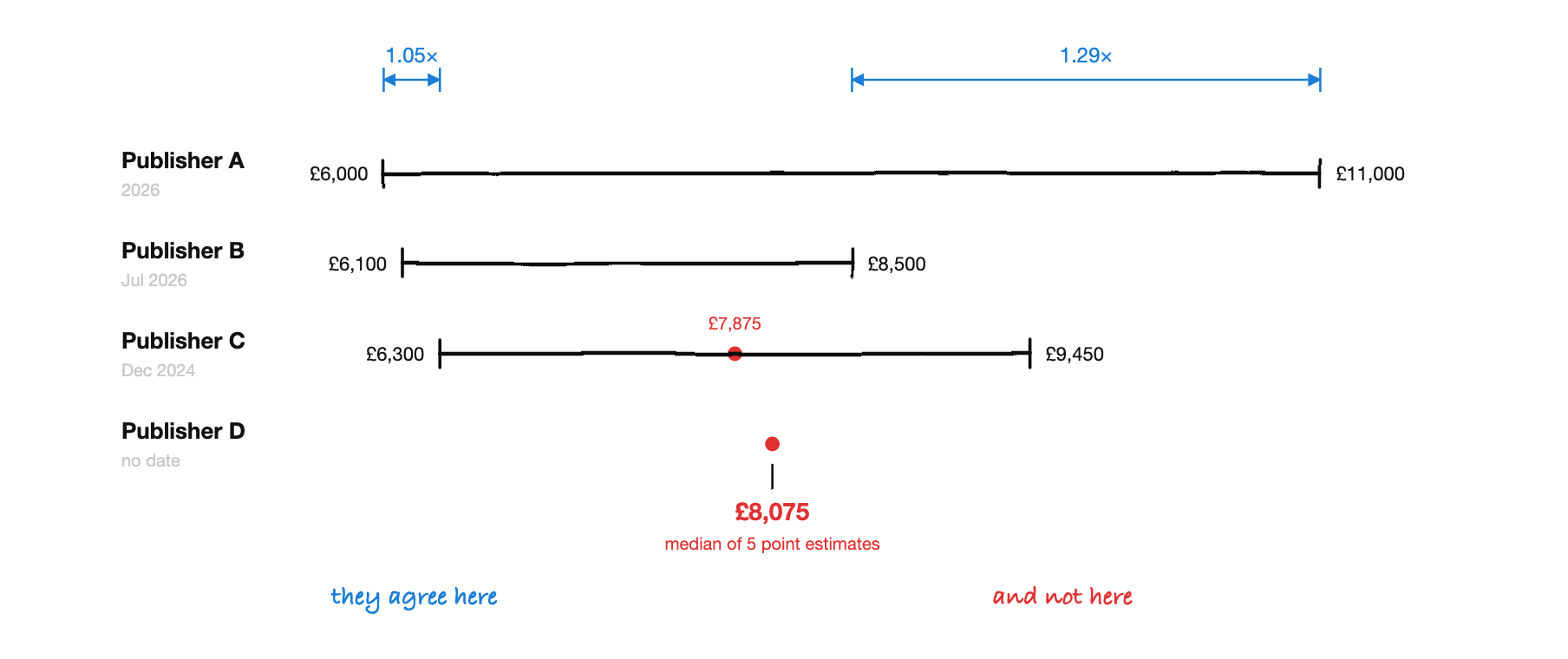
Every mainstream UK source for conservatory prices is a lead generation business, including this one. The difference is what we do about it. Here is one row of the register drawn out in full, so you can see exactly where the agreement stops.
What the rest of this market does
- "Our 15 installers are ready to quote you", where the number is generated at random
- "Good news, we cover your local area", shown to a postcode on the Isle of Skye
- One average price, no source, no date
- An on-page estimator quoting £195/m² against £750/m² in its own body copy
- Pre-ticked marketing consent
What we do instead
- A count only appears if a covered-postcode dataset says so, with its own date
- If you are outside the network we tell you, and you still get your estimate
- A range, a typical, a spread, a source count and a last-checked date on every figure
- Both contradictory figures published, with the reason one is excluded
- Marketing consent is separate, unticked and optional
Only five rows in the whole register clear the top bar, and we say so on every page rather than presenting 222 numbers as if they were equally solid. our costing method and sources.
Who writes this. Every figure on this page is a row in a dated price register with a named source behind it, counted and re-checked on a published schedule. The method, the sources and the business model are each stated in full: how we price, how we make money, the sources behind every figure, and who writes this site.
Planning permission and building regulations
Short answers, because the detail lives on its own pages.
Do you need planning permission?
Most conservatories fall within permitted development: no application, no fee, provided you stay inside the size and boundary limits. Exceed them and you need a householder application.
Do you need building regulations?
A conservatory under 30 m² with an external-grade door is normally exempt. Removing that door, or building a conservatory extension open to the house, pulls the whole job into the regulations.
The exception everybody misses: replacing a translucent conservatory roof with a solid one is regulated building work whoever installs it, and no competent person scheme can sign it off. Who signs off a conservatory roof replacement explains the two routes, LABC or a Registered Building Control Approver, and what the fee buys.
Conservatory, extension or orangery
Three ways to add living space to the back of a house, at three price points, with different rules attached. If the glasshouse itself is the problem, the real alternative to a traditional conservatory is one of the heavier builds below.
| Job | What it is | Rules | Best for |
|---|---|---|---|
| Conservatory | Mostly glazed, its own roof, the cheapest way to add a garden room | Often exempt under 30 m²; permitted development sizes | Natural light and a view of the garden, at a price a family can reach |
| Orangery | A part-solid extension with a glazed lantern, more structure, less glazing | Treated as an extension, not an exempt conservatory | A heavier, warmer room that still carries daylight |
| Extension | A full brick room, insulated and heated like the rest of the house | Full building regulations, often planning permission | Permanent usable floor area, at the highest cost of the three |
A conservatory is usually cheaper than an extension, and the gap narrows as the specification rises: a conservatory built to a heated-envelope standard is effectively being priced against an extension, not against a glasshouse. An orangery sits between the two and is sold on looks, not value per pound. The full side-by-side, with cost bands and the cases where each one wins, is on the conservatory vs extension page.
Does a conservatory add value?
It can, in the way any extra usable room can. What it will not do is add value in proportion to what it cost.
The honest version is that a conservatory adds value only to the extent that it adds usable floor area, and a glasshouse that is too hot in summer and too cold in winter is not usable floor area for most of the year. A conservatory you can use all year round is a room; one you cannot is a covered patio that appears on the floor plan. That is why the roof, not the size, is the part of the specification that decides whether the money comes back: it is the difference between 1.00 to 1.30 W/m²K for a glass roof and 0.15 for an insulated solid one, per Approved Document L Table 4.2.
If you are buying to sell, a smaller room that works in January is worth more than a bigger one that does not. If you already own a conservatory you cannot use, the question is not what a new one costs, it is what the roof costs: £8,075 against £10,000 at 3m × 3m, so most of the price rather than a fraction of it.
How to keep the cost of a conservatory down
The levers that actually move the final cost, in order of how much they move it.
Size, then style
The size of the conservatory sets the base and the glazing area, and the style of conservatory sets how much frame both need. A plain lean-to at the footprint you need beats a fancy footprint you heat and never use.
uPVC, unless you have a reason
Aluminium and timber are more expensive than uPVC at +25% and +65% typically, and aluminium is thermally worse. Pay for the roof and the glazing first; the frame material is a finishing decision.
Stages, not shortcuts
Keep a sound existing base, defer electrics and blinds to a later job, and never buy a cheaper roof to save money: it is the part that decides whether the room works. Conservatory kits and finance to spread the cost exist, but a kit is supply only and finance is not a discount.
The one thing only a survey can tell you
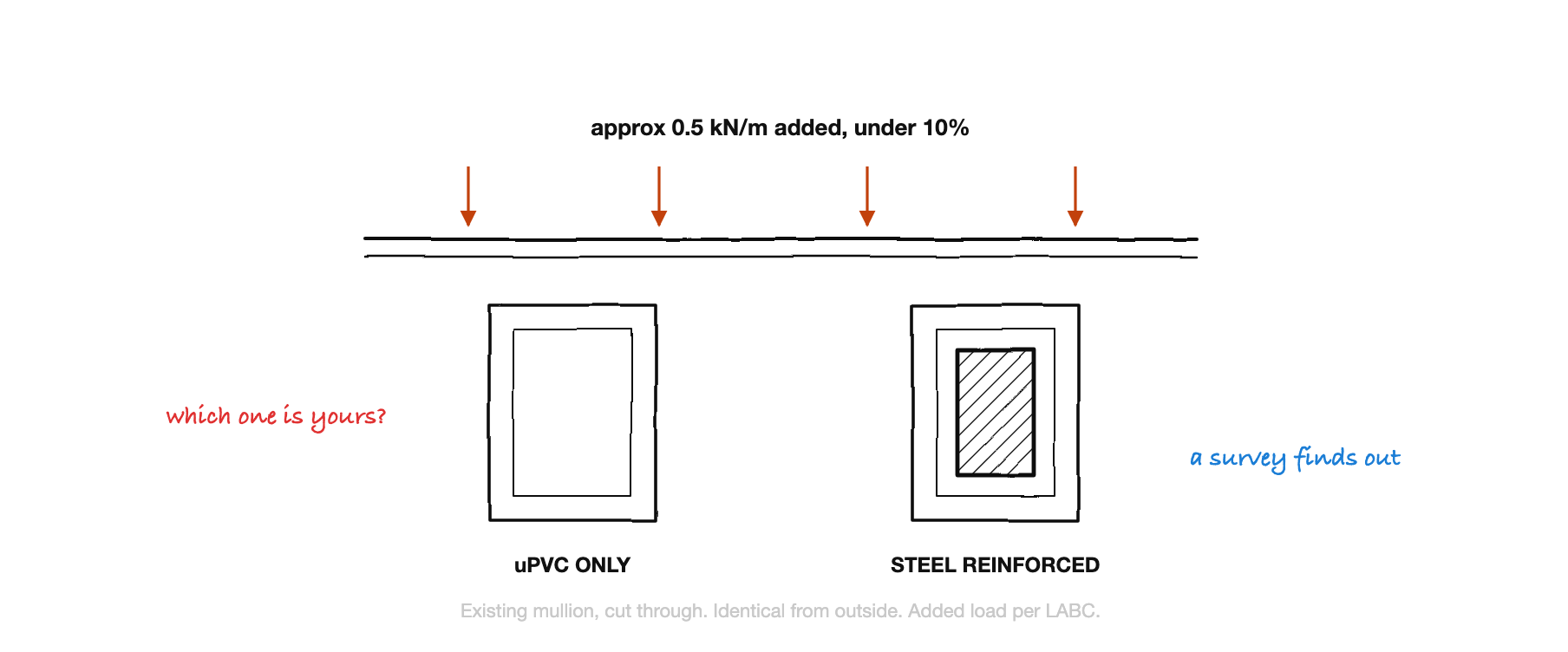
A solid roof weighs more than the polycarbonate it replaces. Whether your existing frames can carry it comes down to something you cannot see from the outside, and it is the commonest reason a quote changes after the survey.
1. Answer six questions
Your roof, your size, your timescale. No phone number until the final step, and no email needed to see an estimate.
2. See your estimate and the sources
A range, never a single number, with the evidence grade, the source count and the date beside it. If we do not have a defensible figure for your exact job, we say so.
3. Up to 4 local installers call you
They confirm the details and arrange a free, no obligation survey or quotation. What is under your ground or inside your frames is settled on that visit, not by a form.
Questions people ask first
What is the average cost of a conservatory in the UK?
About £15,000 installed, with a normal range of £9,000 to £25,000. That average is one UK quote comparison site's stated figure and it sits at the midpoint of the four other published ceilings we hold. We show a range rather than a single number because the published sources disagree by 1.63× at the top end.
How much does a 3m x 3m conservatory cost?
A lean-to at 3m × 3m is £8,000 to £13,000, typically £10,000. Two independent publishers four months apart put the floor at exactly £8,000, which is the strongest agreement anywhere in our new-build data.
Is a conservatory cheaper than an extension?
Usually, and the gap narrows as the specification rises. A conservatory built to a heated-envelope standard is being priced against an extension, not against a glasshouse.
Do I need planning permission for a conservatory?
Most fall under permitted development, and a conservatory under 30 m² is normally exempt from building regulations too. Replacing an existing conservatory roof with a solid one is different: that is regulated building work and it goes to LABC or a Registered Building Control Approver.
Is there a cheaper alternative to a conservatory?
If you already own one, yes: insulating the roof you have costs a fraction of replacing it and fixes the winter half of the problem, though not the summer half. If you do not, the honest answer is that a cheap new conservatory is a room you will not use, and a better plan is a smaller, better-specified build. The methods and where they fail are on the conservatory insulation cost guide.
How much does a large conservatory cost?
A P-shape at 15 to 20 m², the largest style most UK installers price routinely, runs £13,250 to £19,700 installed including VAT, typically £16,750, from three publishers. Above that you are into bespoke work, and no UK publisher prices it honestly, so neither do we.
Which type of conservatory is cheapest?
A lean-to, at every size any UK publisher prices, because a rectangular plan and a single pitched roof need less frame, less glazing and less labour. The style-by-style working, at matched footprints rather than the mixed sizes most comparisons use, is on conservatory styles and what each one costs.
Can you use a conservatory all year round?
It depends almost entirely on the roof, not on the heating. Approved Document L Table 4.2 puts polycarbonate at 1.78 to 2.40 W/m²K and a glass roof at 1.00 to 1.30, against 0.15 for an insulated solid roof. That is roughly a tenfold difference in heat loss through the largest surface of the room, and no amount of radiator will close it while the roof is still the problem. A conservatory with a solid or tiled roof behaves like a room in the house; one with polycarbonate is unusable at both ends of the year.
Find out what yours costs
Six questions, about sixty seconds, and an estimate built from published UK figures with every source shown. Then up to four local installers can quote you, if you want them to.